


A shipment can leave Turkey on schedule and still cause problems if the order details, paperwork, or delivery checks do not match. To import underwear from Turkey successfully, manage the information at every handoff, not just the freight booking.
Unclear details about sizes, materials, colours, or quantities can lead to order discrepancies. Incomplete shipping information can also complicate customs clearance. For Tunisian buyers, check destination requirements against current official guidance before the goods ship.
This guide covers the order-to-delivery process, from defining product specifications and quantities to reviewing the commercial invoice, packing list, and transport documents. It also explains how to plan freight around stock needs and check delivered goods against the purchase order. Use these steps to prepare accurate information, coordinate with your Turkish supplier, and reduce avoidable surprises when your underwear shipment reaches Tunisia.
Key Takeaways
- Map the order-to-delivery steps before you import underwear from Turkey, from agreeing product details to receiving and reconciling the shipment.
- Specify product type, sizes, colours, and quantities clearly to reduce the risk of order discrepancies.
- Prepare commercial and shipping records together, then verify Tunisia-specific requirements against current official guidance.
- Choose air or sea freight based on urgency, shipment size, handling, and stock planning, and agree responsibilities before dispatch.
- Set inspection checks before shipment and compare delivered goods with the order and records to identify discrepancies promptly.
How importing underwear from Turkey works: the order-to-delivery route
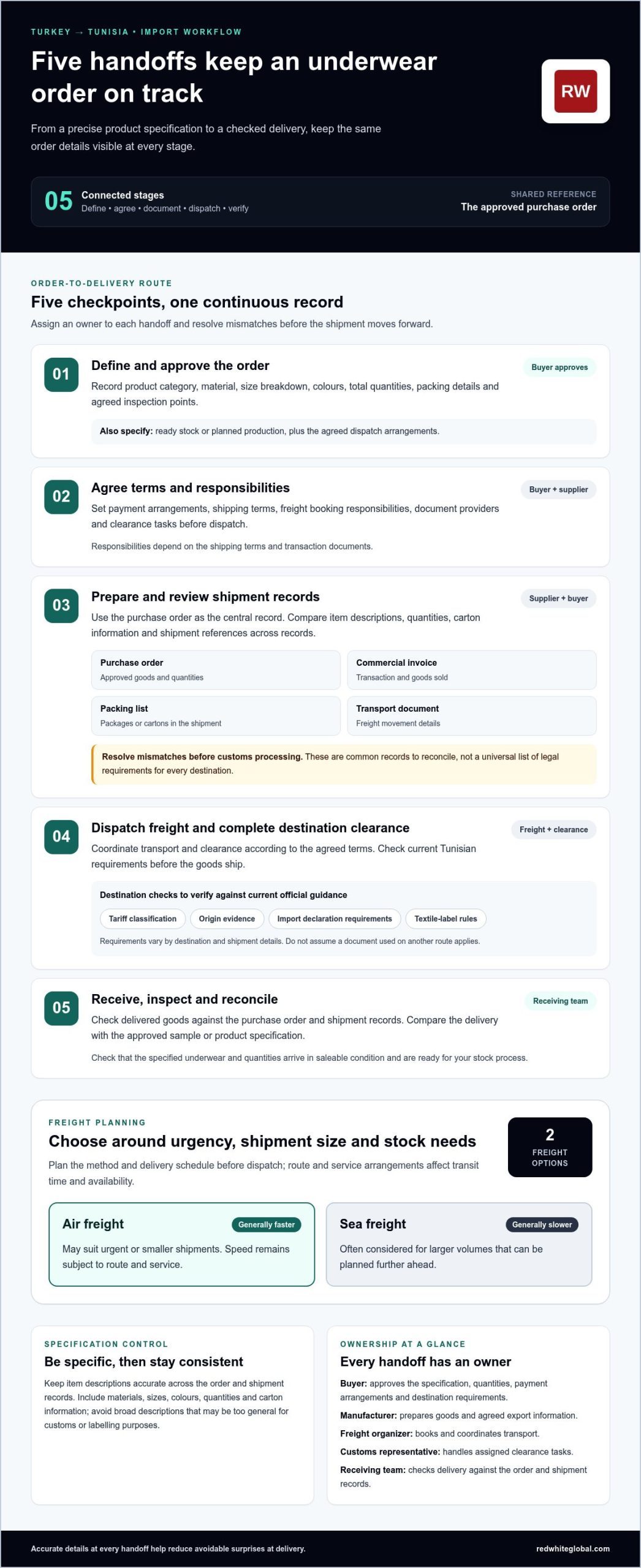
The goal is to receive the specified underwear and quantities, with the required documents, in saleable condition and ready for your stock process. Importing means moving goods across a customs border. To import underwear from Turkey into Tunisia, manage the order as a sequence of handoffs: define the goods, agree transaction and shipping terms, prepare records, dispatch freight, complete destination clearance, and check the delivery.
Turkey has an established textile and clothing industry, as outlined in this Textile and clothing industry in Turkey overview. However, the goods’ country of origin does not determine Tunisia’s import requirements. Customs procedures, taxes, and product rules depend on the destination and shipment details. Verify current Tunisian requirements with official sources before dispatch.
What to settle before placing a wholesale underwear order
Write the order specification so both parties can use it for production, packing, and later checks. Record the product category, material, size breakdown, colours, total quantities, packing details, and agreed inspection points. Identify whether the order is for ready stock or planned production, and record the agreed dispatch arrangements. For product-level buying considerations, see the wholesale boys’ boxers sourcing guide.
Who handles each step from Turkey to destination
Assign an owner to each handoff. The buyer approves the specification, quantities, payment arrangements, and destination requirements. The manufacturer prepares the goods and agreed export information. The freight organizer books and coordinates transport, while the customs representative handles their assigned clearance tasks. The receiving team checks the delivery against the order and shipment records.
Responsibilities depend on the shipping terms and transaction documents. Before dispatch, specify who arranges freight, provides each record, and manages clearance. A simple sequence keeps the workflow visible:
- Define and approve the order.
- Agree transaction terms and responsibilities.
- Prepare and review shipment documents.
- Dispatch freight and complete destination clearance.
- Receive, inspect, and reconcile the goods.
Prepare the order details and documents before underwear ships
Accurate paperwork starts with a clear order record. The exact documents and checks depend on the destination, shipment route, and agreed transaction terms. For an import into Tunisia, verify the tariff classification, origin evidence, import declaration requirements, and any textile-label rules against current official Tunisian guidance before dispatch. Do not assume that a document used on another route applies to your shipment.
Consistent product descriptions and quantities help align order records with shipping documents. They give the buyer, manufacturer, freight organizer, and customs representative a shared reference when preparing and reviewing the shipment.
Build one accurate product and order record
Use the purchase order as the central record, then compare each document against it. Include specific item descriptions, materials, size breakdowns, colours, quantities, and carton information. Keep any approved sample or product specification with the order so the receiving team can compare the delivery with what was agreed.
A broad description such as “underwear” may be too general for customs or labelling purposes. Describe the goods accurately and consistently, without adding details that do not match the products.
Review commercial and transport documents
The commercial invoice records the transaction and the goods being sold. The packing list shows how the shipment is grouped into packages or cartons. A transport document, such as a bill of lading or air waybill, records details of the freight movement. These are common records to reconcile, not a universal list of legal requirements for every destination.
Before dispatch, compare buyer and seller details, product descriptions, quantities, carton information, and shipment references across the purchase order, invoice, packing list, and transport document. Resolve mismatches before the records move to customs processing. Requirements for certificates, declarations, origin evidence, and textile labels vary by destination, so check current local rules.
The U.S. International Trade Administration’s guide to import requirements and documentation concerns goods entering Turkey, so it does not establish Tunisia’s import rules. Use it for context only and verify the requirements for the Tunisian destination. A coordinated export file also helps keep order details aligned with shipment paperwork. RedWhite Global manufactures cotton underwear in Turkey and supplies B2B buyers.
Choose freight and check customs requirements for the destination
Plan freight around the stock requirement, shipment size, and delivery schedule. Air freight may suit urgent or smaller shipments, while sea freight is often considered for larger volumes that can be planned further ahead. Transit times and service availability depend on the route and arrangements. Compare the options before dispatch, then agree who books transport, manages each handoff, and coordinates destination clearance under the transaction terms.
Match the freight method to the stock requirement
| Factor | Air freight | Sea freight |
|---|---|---|
| Relative speed | Generally faster, subject to route and service | Generally slower, so allow more planning time |
| Capacity | Often suited to smaller or time-sensitive shipments | Often suited to larger shipments |
| Planning | Coordinate shipment readiness and booking carefully | Allow for transport planning and delivery coordination |
| Stock fit | Consider when replenishment urgency is a priority | Consider when volume and advance planning support it |
Consolidating the shipment with other goods may be possible if the order and logistics plan support it. Check that handling, packaging, and delivery coordination suit the goods and schedule.
Prepare for destination-country customs clearance
For businesses planning to import underwear from Turkey into Tunisia, current guidance from the relevant Tunisian authorities is the reference point. Confirm the tariff code for the specific goods, applicable duty and tax treatment, and clearance rules before booking freight. Confirm HS classification and duty treatment for the products and destination instead of inferring them from a general description or another country’s rules.
Product composition, origin, packaging, and labelling may affect classification or entry requirements. Keep these details consistent across the order and shipment records, and establish how origin will be evidenced if required. The cited customs requirements for the destination guide covers UK imports. It offers route-specific context, but is not a substitute for Tunisia’s current rules.
Before dispatch, record the agreed route, delivery terms, and the party responsible for freight organization and clearance. Clear allocation helps each participant prepare for their handoff and gives the importer time to align shipment planning with stock needs.
Inspect the underwear order and manage delays before receipt
Agree inspection checks before the goods move. Keep two stages distinct: a pre-dispatch quality inspection checks the goods before shipment, while the importer’s receiving check confirms what arrived against the order and shipment records. Neither replaces the other. If a transport delay changes your stock plan, update the receiving team and keep revised shipment information with the order file.
Set inspection points against the confirmed specification
Define what will be checked and how results will be recorded. Depending on the agreed scope, compare style, material description, size assortment, workmanship, packing, and carton labels with the confirmed specification. Samples can show the intended product, but only if the approved sample represents the ordered specification. Keep written specifications and samples as references, alongside a clearly defined inspection scope.
RedWhite Global coordinates quality assurance inspection for wholesale orders. Agree the inspection points and records to be shared so both parties use the same criteria.
Record shipment exceptions and protect replenishment planning
At receipt, compare the delivery with the confirmed order and note any observable differences before reconciling stock. Receiving checks should compare delivered quantities and product details with the confirmed order. Check carton counts, labels, size breakdowns, product descriptions, and visible condition against your records.
- Record shortages, damaged cartons, mismatched labels, or other differences.
- Take dated photographs and note the affected carton references.
- Keep delivery records, the purchase order, packing list, and inspection notes together.
- Reconcile accepted quantities and document unresolved discrepancies for follow-up.
Clear records help the buyer and supplier discuss a specific issue using the same evidence. They also show which sizes or product details may affect available stock, allowing you to adjust replenishment plans instead of relying on an unverified receipt total.
For buyers importing underwear from Turkey, a written sequence keeps quality review separate from delivery reconciliation: agree the checks, inspect against the specification, document exceptions, then confirm receipt. RedWhite Global works with B2B buyers on cotton underwear orders and coordinates quality assurance inspection. Discuss wholesale underwear order coordination as you prepare the inspection plan.
Import underwear from Turkey with a coordinated manufacturing partner
A controlled import plan connects product selection, order records, inspection, and freight responsibilities before goods leave Turkey. For Tunisian wholesalers, current destination customs and product requirements are an essential part of that plan. RedWhite Global is a Turkish B2B cotton underwear manufacturer with over 20 years of export experience and production capacity of up to one million pieces per month.
Use samples, ready stock, and factory visits to inform sourcing
Free samples let wholesale buyers assess product characteristics before placing an order and compare them with the written specification. Ready-stock orders offer a sourcing option, while planned production can suit a different order plan. Agree dispatch arrangements as part of the order. Factory visits give buyers an opportunity to observe operations directly and understand the manufacturing setting behind their order.
Move from an import plan to a wholesale order discussion
Before discussing a wholesale order, organize the information that will shape sourcing and shipment planning: product categories, quantities, size assortment, and destination. RedWhite Global supplies cotton underwear for women, men, girls, and boys, as well as tank tops. A clear specification gives the manufacturer and buyer a practical foundation for coordinating the order.
Use this pre-dispatch checklist to close gaps before freight is arranged:
- Specification: Record product category, material, sizes, colours, packing, and agreed inspection points.
- Quantity: Confirm total units and size assortment against the purchase order.
- Documents: Reconcile product descriptions and quantities across relevant shipment records.
- Freight plan: Agree the route, transport method, and responsibility allocation.
- Inspection: Set pre-dispatch checks and plan how receipt will be compared with the confirmed order.
These steps give businesses looking to import underwear from Turkey a shared order reference before dispatch and a clear basis for checking the delivery. To discuss a wholesale order, prepare the product categories, quantities, assortment, and destination. Discuss a wholesale underwear order with RedWhite Global.
Put your next underwear import plan into action
To import underwear from Turkey with fewer avoidable surprises, define the product specification and quantities before placing the order, then keep those details consistent across the commercial and shipping records. Agree freight responsibilities in advance, verify current customs and product requirements for Tunisia through official sources, and compare delivered goods with the confirmed order before reconciling receipt.
RedWhite Global is a Turkish B2B cotton underwear manufacturer with over 20 years of export experience and facility capacity of up to one million pieces per month. Wholesale buyers can use free samples to assess product characteristics, arrange factory visits to observe operations, and coordinate quality assurance inspection as part of order planning.
Bring your product categories, quantities, size assortment, and destination into the order discussion. Discuss a wholesale underwear order with RedWhite Global.
Frequently Asked Questions
How do I import underwear from Turkey?
Import underwear from Turkey by confirming the products and quantities, agreeing transaction and freight responsibilities, preparing shipment records, and arranging transport and destination clearance. For Tunisia, verify current customs, tariff, tax, and product requirements with official Tunisian guidance before dispatch. Keep the product specification consistent across the order and shipping paperwork, then check delivered quantities and details against the approved order before reconciling receipt.
What documents are needed to import underwear from Turkey?
Common shipment records include a commercial invoice, packing list, and transport document, such as a bill of lading or air waybill. Depending on the destination, route, and transaction terms, origin evidence, certificates, declarations, or other records may also apply. Check Tunisia’s current import requirements and compare buyer and seller details, goods descriptions, quantities, and shipment references across documents before the goods leave Turkey.
Do I have to pay import duty on underwear from Turkey?
Whether duty applies, and how much, depends on the specific goods and destination rules. For an import into Tunisia, confirm the correct HS tariff classification and applicable duty and tax treatment through current official Tunisian sources or with your customs representative. Do not assume that a tariff rate or preferential treatment described for another country applies to Tunisia, or that a general underwear description determines the classification.
How is underwear shipped from Turkey to another country?
Wholesale underwear can move by air or sea freight, depending on shipment size, urgency, route, service availability, and stock planning. Air freight may suit smaller or time-sensitive consignments; sea freight may suit larger shipments with more time for planning. Actual transit times vary by route and arrangements. Agree who books freight, manages each handoff, and coordinates destination clearance before dispatch.
How can I check the quality of a bulk underwear order before shipment?
Agree inspection points against the written specification before dispatch. Checks may cover product type, material description, size assortment, workmanship, packing, and carton labels, according to the agreed scope. Compare samples only when the approved sample represents the ordered specification. RedWhite Global coordinates quality assurance inspection for wholesale buyers. After delivery, conduct a separate receiving check against the order and shipment records, then document any discrepancies.
Can I import ready-stock underwear from Turkey?
Yes, ready-stock orders are a sourcing option for wholesale buyers importing underwear from Turkey. RedWhite Global supplies cotton underwear to B2B wholesalers and retailers, and its orders are shipped from ready stock. Align the product categories, size assortment, and quantities with your purchasing plan, then coordinate the order and freight details.
How do I avoid delays when importing underwear?
Reduce avoidable delays by settling product details and quantities early, checking invoice and packing information for consistency, and agreeing freight responsibilities before dispatch. Confirm Tunisia’s current classification, clearance, tax, and product requirements through official guidance rather than relying on rules for another destination. Share shipment updates with your receiving team, plan around the agreed freight route, and keep order and delivery records together so issues can be addressed promptly.

