A production-capacity figure alone does not prove that an order will arrive on time or meet the same standard across every unit. In high volume underwear manufacturing, dependable results start with matching available capacity to repeatable quality checks and a clear fulfillment plan.
Buyers should look beyond a supplier’s stated output. Large orders can expose gaps in materials planning, size specifications, inspection processes, and shipment coordination. Clear requirements and direct confirmation help identify those risks before production begins.
This guide covers the main stages of high-volume underwear production and how to prepare an order brief a manufacturer can assess. You’ll learn what to confirm about capacity and product mix, how to define specifications and inspection expectations, and how to connect order quantities with shipment planning. Use these steps to compare suppliers based on specific answers, not broad promises, before committing to an order.
Key Takeaways
- Separate ready-stock purchasing from bulk production, then choose the route that fits your requirements.
- Build quantities from a sales forecast and clearly specify product mix, sizes, materials, and other requirements.
- Assess factory readiness by checking product fit, available capacity for your order, inspection processes, stock, and fulfillment coordination.
- Agree on inspection checkpoints before production starts. Use samples to assess product details, not to predict the quality of the entire run.
- Use a consistent inquiry checklist for high volume underwear manufacturing to make supplier responses easier to compare.
What High-Volume Underwear Manufacturing Involves
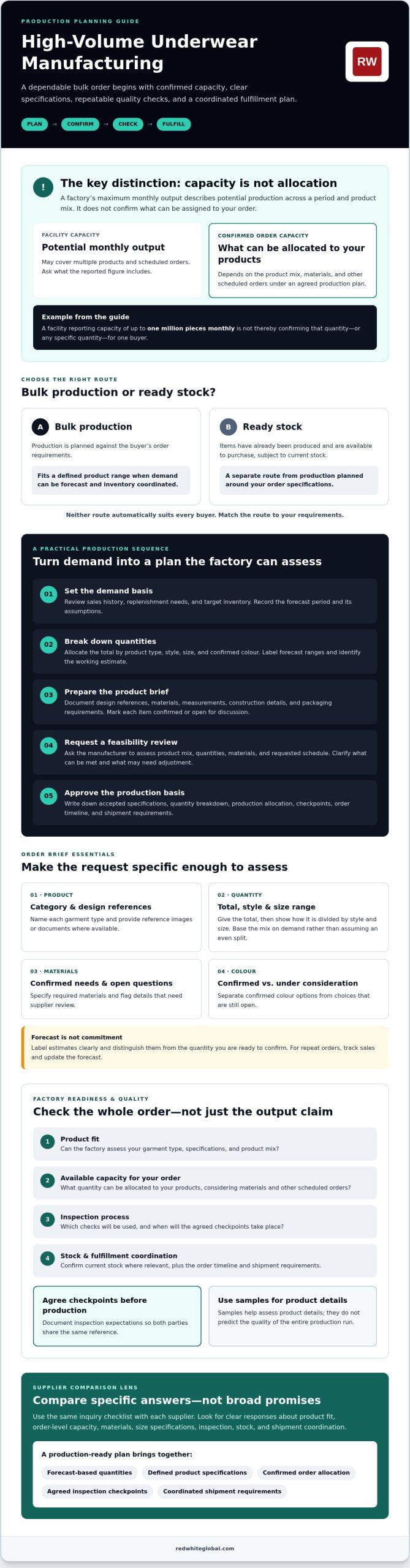
High-volume underwear manufacturing is production planned around both a buyer’s forecast demand and the factory’s available capacity. An order may cover one product or a mix of categories, sizes, and confirmed colours. The volume is agreed for a specific order. A factory’s maximum monthly output alone does not define what it can produce for one buyer.
Monthly facility capacity describes potential production across a period and product mix. Confirmed order capacity is the amount a manufacturer can allocate to your products under an agreed production plan. It may depend on materials, other scheduled orders, and the styles being made. For example, a facility that reports capacity of up to one million pieces monthly is not confirming that quantity, or any specific quantity, for one buyer. Ask what the figure covers and what can be allocated to your order.
Bulk production and ready-stock purchasing are different options. Bulk production is planned against an order’s requirements. Ready stock consists of items already produced and available for purchase, subject to current stock. Neither route automatically suits every buyer. The textile manufacturing process provides background on how fibre becomes fabric, one of the upstream stages that supports garment production.
When does high-volume underwear production make sense?
Planned production can suit wholesale replenishment, retail distribution, or a defined product range when the buyer can forecast demand and coordinate inventory. Use sales forecasts and stock targets to set quantities by product and size. For repeat orders, track sales and update the forecast rather than relying on a previous order quantity. The right scale depends on your requirements and the supplier’s confirmed capacity for the product mix.
What does a manufacturer need before assessing an order?
Prepare a brief that separates firm requirements from preferences that are still open to discussion. Include:
- Product category and design references: Identify each garment type and provide reference images or documents where available.
- Size range and quantities: State the total quantity, then break it down by style and size.
- Material requirements: Specify confirmed material needs and flag any details that require supplier review.
- Colour options: List confirmed colours separately from options still under consideration.
This gives the manufacturer a clearer basis for assessing product fit, materials, and order allocation. Mark what must be followed and what can be discussed before requesting a production assessment.
How to Plan High-Volume Underwear Production Step by Step
A controlled production plan turns a sales requirement into instructions a factory can assess and confirm. In high volume underwear manufacturing, written decisions give both parties a shared reference for quantities, product specifications, and changes made before production starts.
- Set the demand basis. Review sales history, replenishment needs, and target inventory. Record the period covered by the forecast and note assumptions, such as expected repeat orders or distribution across sales channels.
- Build the quantity breakdown. Divide the requested total by product type, style, size, and confirmed colour. A single overall figure does not show how pieces should be allocated. If demand is uncertain, provide a forecast range and identify the working estimate.
- Prepare the product brief. Document design references, material requirements, measurements, construction details, and packaging requirements. Mark each item as confirmed or open for discussion so the manufacturer can distinguish requirements from preferences.
- Request a feasibility review. Ask the manufacturer to assess the product mix, quantities, materials, and requested schedule. Confirm which requirements can be met and what may need adjustment before approving the plan.
- Approve the production basis. Record the accepted specifications, quantity breakdown, production allocation, and agreed checkpoints in writing. Confirm the order timeline and shipment requirements with the manufacturer rather than relying on assumptions.
Turn demand forecasts into an order brief
Use replenishment patterns and inventory targets to explain the quantities you’re requesting. If one size sells faster than another, reflect that in the size allocation instead of applying an even split without evidence. Label forecast figures as estimates and distinguish them from the quantity you’re ready to confirm. This helps the factory assess the request without mistaking a planning range for a firm order.
Confirm specifications and production planning
Before approval, check that the manufacturer has reviewed the materials, measurements, construction details, and packaging requirements in your brief. Don’t treat a preference as an agreed specification until the factory confirms it can meet it. Agree how proposed changes will be submitted, reviewed, and approved, and keep the updated record with the order documents.
RedWhite Global manufactures cotton underwear for women, men, girls, and boys, and works with wholesale buyers on bulk production and ready-stock orders. Discuss your product requirements and confirm which specifications, inspection coordination, and freight arrangements apply to your order. A clear brief makes that conversation more practical and keeps planning tied to agreed requirements.
How to Assess a Factory’s Capacity and Production Readiness
A factory’s headline output is only a starting point. For high volume underwear manufacturing, buyers need to establish whether the supplier can allocate capacity to the requested product mix and schedule, and explain how quality checks and fulfillment will be managed.
Facility capacity describes what a factory may produce. A confirmed production commitment states what it has allocated to your order and when. Ask whether the stated figure reflects maximum capability, typical output, or current available allocation. RedWhite Global reports facility capacity of up to one million pieces monthly, but that figure is not a commitment to a specific order. Confirm its current status and the product mix it covers directly with the manufacturer.
| Assessment area | What to verify | Useful question |
|---|---|---|
| Stated capacity | Maximum output, typical output, or allocation available now | “What quantity can you allocate to this order, based on its product mix?” |
| Product fit | Readiness to produce the requested categories and specifications | “Can you confirm this product mix and its requirements are within your current capability?” |
| Inspection process | Order-specific inspection stages, records, and handling of deviations | “Which checks and records can be agreed for this order?” |
| Stock | Whether requested goods are ready stock or require production | “Which quantities are currently available, and which need to be produced?” |
| Fulfillment coordination | How packing, shipment planning, and responsibilities will be confirmed | “What shipment details and coordination can you confirm for this order?” |
Which capacity questions should buyers ask?
Share the quantity breakdown by product type, size, and confirmed colour, then ask how the factory’s stated output applies to that mix. Confirm current workload, material availability, and whether the proposed production allocation fits your requested schedule. Fabric is an upstream consideration for cotton garments. Buyers can review the cotton fabric manufacturing process while asking how material readiness affects their order. Request an order-specific response, not just a general capacity statement.
How can buyers evaluate quality oversight?
Ask which inspection stages can be arranged for your order, what records will be shared, and how defects or specification deviations will be documented and addressed. Agree on the process before production begins. For product-specific sourcing considerations, consult the boys’ boxers sourcing guide.
How to Coordinate Quality Checks, Samples, and Order Fulfillment
Quality control works best when the buyer and manufacturer agree on the process before production starts. For high volume underwear manufacturing, define what will be checked, when checks will happen, who will coordinate them, and what records the buyer will receive. Confirm the inspection scope for the specific order rather than assuming every supplier follows the same procedure.
How should samples inform a bulk order?
Review a sample against the written brief. Check relevant details such as material, fit, measurements, construction, and any confirmed colour or trim requirements. Record the approved sample reference and ask the manufacturer to confirm whether production will follow it. A sample helps assess the reference product, but it cannot establish that every unit in a future run will match. Set separate inspection checkpoints for production.
Before approval, agree how the factory will report a deviation from the sample or specifications, who will review it, and whether production should pause while a decision is made. Keep the approved reference and any written change approvals with the order records.
What should an order fulfillment plan confirm?
Assign responsibilities in writing so inspection and shipment tasks don’t fall between parties. Confirm who coordinates each applicable step:
- Inspection: Agree who arranges checks, which stages are covered, and how findings are recorded and shared.
- Shipment preparation: Confirm who checks packing details and prepares the order for handoff.
- Freight and communication: Identify who coordinates freight, provides shipment updates, and answers order-related questions.
- Documentation: Ask the export team which shipping documents are required for the specific order and destination, and confirm who prepares and reviews them.
Confirm the lead time, inspection scope, freight arrangements, and handoff points in writing for each order. These details can depend on the product mix and shipment plan, so don’t treat estimates or general supplier descriptions as final confirmation. RedWhite Global coordinates inspection and international freight for wholesale buyers. Confirm which arrangements apply to your order.
For a product-specific example, review these boys’ patterned boxer sourcing criteria alongside your own quality requirements. To discuss samples, inspection coordination, or freight planning for wholesale products, contact RedWhite Global and confirm the current terms for your order.
From Factory Assessment to Production-Ready Partnership
A useful first inquiry gives manufacturers enough detail to assess the order and gives you a clear basis for comparing their responses. For high volume underwear manufacturing, focus on product fit, evidence, and written confirmation rather than broad capacity claims alone.
What information should a first manufacturer inquiry include?
Identify your business as a wholesale buyer, list the product categories, and provide estimated quantities by style, size, and confirmed colour options. State your intended order schedule and target shipment requirements. Attach approved specifications or mark details that still need discussion. This helps a factory assess the request against its current product capability and available production allocation.
- Product mix and quantities: Include each category and quantity breakdown, noting any forecast ranges or assumptions.
- Specifications: Share confirmed material, measurement, construction, and packaging requirements, along with relevant references.
- Samples and quality checks: Ask whether relevant samples are available and which inspection coordination and records can be confirmed for the order.
- Fulfillment: Ask who will coordinate freight, shipment preparation, required documentation, and buyer updates.
Compare replies against the same information. A response that clarifies open requirements and identifies what still needs confirmation is more useful than an unqualified capacity statement.
How can buyers verify the working relationship?
Use direct discussions to check whether the manufacturer understands your specifications and can explain the order plan. Review available samples against the brief, and ask whether a factory visit can be arranged. Confirm current availability and terms for both. RedWhite Global reports over 20 years of export experience and facility capacity of up to one million pieces monthly. Treat these as points to discuss and verify, including whether the capacity figure is current and which product mix it covers.
Before production is confirmed, document approved specifications, quantities, inspection responsibilities, shipment arrangements, and any unresolved conditions. This record gives both parties a shared basis for managing the order and reviewing changes.
For wholesale buyers assessing high volume underwear manufacturing, a well-defined inquiry makes the next conversation more practical. Contact RedWhite Global to discuss your product mix and order requirements with its export team, and confirm the details that apply to your inquiry.
Make Your Next Production Decision with Confidence
Successful high volume underwear manufacturing depends on more than a headline capacity figure. Match order quantities to your forecast, document product specifications clearly, and confirm the factory’s allocation, inspection scope, and shipment responsibilities in writing.
Samples and factory discussions can help you assess product details and working processes, but they don’t replace order-specific quality checks or written production confirmation. RedWhite Global reports over 20 years of export experience and facility capacity of up to one million pieces monthly. Verify the capacity’s current scope and product mix, along with the terms for samples and factory visits, before relying on them in your plans.
Prepare your product mix, quantity assumptions, specifications, and target shipment requirements before approaching a manufacturer. Then compare responses against those details. Contact RedWhite Global to discuss your wholesale production requirements and ask whether your order fits its current production plans. A clear brief is a practical first step toward a well-managed order.
Frequently Asked Questions
What is considered high-volume underwear manufacturing?
High-volume underwear manufacturing means producing planned quantities that match a buyer’s demand and a factory’s available capacity. There is no single quantity that defines it for every order. A wholesale replenishment order may be high volume for one buyer but not another. Assess the quantity alongside product categories, size and colour mix, forecast demand, and the supplier’s confirmed allocation, not only its monthly facility maximum.
How do I assess an underwear manufacturer’s production capacity?
Ask whether the stated output represents maximum capability, typical production, or capacity currently available for your order. Share your product categories and quantities by style and size, then request confirmation of the allocation and schedule for that product mix. Also ask about current workload, material readiness, inspection coordination, and fulfillment responsibilities. Compare specific answers with your requirements rather than treating a general monthly capacity figure as an order commitment.
What information should I provide for a bulk underwear manufacturing inquiry?
Identify your business as a wholesale buyer and list product categories, estimated quantities, intended order schedule, and target shipment requirements. Break quantities down by style, size, and confirmed colour options rather than providing only a total. Attach available specifications and design references, including material, measurements, construction, and packaging requirements. Mark which details are fixed and which still need discussion so the manufacturer can assess the request accurately.
Should I approve a sample before placing a large underwear order?
Review a relevant sample before confirming a large order when one is available and appropriate for your requirements. Compare it with the written brief for material, fit, measurements, construction, and other specified details. Keep a record of the approved reference and ask whether production will follow it. A sample helps assess the example reviewed, but it does not verify every unit in a future production run. Agree on separate inspection checks.
How is quality checked during high-volume underwear production?
Quality checks should follow an agreed, order-specific plan. Before production begins, confirm which stages will be inspected, which product requirements will be checked, and what records can be shared. Ask how the manufacturer documents defects or specification deviations, who reviews findings, and how corrective actions are recorded. Don’t assume an inspection scope based on a general supplier description. Confirm which quality assurance inspection coordination applies to your order.
Can a manufacturer produce a million underwear pieces per month?
Some facilities report capacity at that scale, but a monthly maximum does not confirm that one million pieces can be allocated to a particular buyer or product mix. RedWhite Global reports facility capacity of up to one million pieces monthly. Buyers should verify whether the figure is current, which products it covers, and what quantity and schedule the factory can confirm for their order, given its workload and production plan.
What is the difference between ready stock and made-to-order underwear?
Ready-stock underwear has already been produced and may be available for purchase, subject to current inventory and product options. Made-to-order or bulk production is planned against a buyer’s confirmed requirements and requires the manufacturer to assess capacity, specifications, and timing. Ask which quantities are in stock and which need production. Neither route suits every order, so compare availability and confirmed fulfillment arrangements with your needs.